
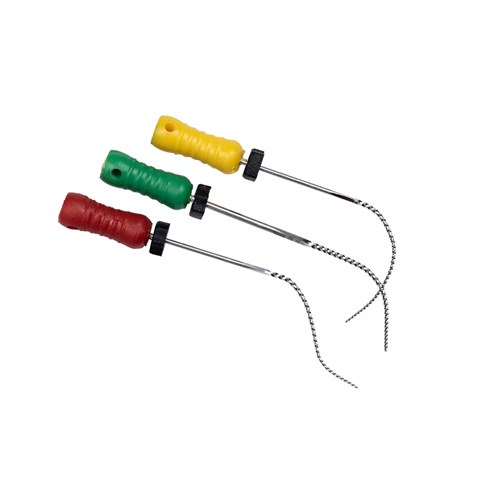
In the context of endodontics (root canal treatment), files are the primary instruments used to clean, shape, and debride the root canal system. They have evolved from simple hand-held stainless steel wires to high-tech, flexible nickel-titanium (NiTi) rotary systems.
Description
Endodontic files are tapered, pointed instruments with cutting edges (flutes) along their working part. They are designed to remove infected dentin and pulp tissue while shaping the canal to allow for effective irrigation and subsequent filling (obturation).
They are generally categorized by:
- Material: Stainless Steel (SS) or Nickel-Titanium (NiTi).
- Operation: Hand files or Rotary/Reciprocating engine-driven files.
- ISO Standards: Color-coded handles represent specific diameters at the tip (e.g., White = 15, Yellow = 20, Red = 25).
Key Features
- Taper: The rate at which the file diameter increases from the tip. Traditional hand files have a constant .02 taper, while modern rotary files often have larger or variable tapers (e.g., .04 or .06).
- Flexibility: NiTi files possess “shape memory” and super-elasticity, allowing them to follow the natural curve of a root canal without straightening it (transportation).
- Cutting Efficiency: The design of the “flutes” (the grooves) determines how effectively the file cuts dentin and hauls debris out of the canal.
- ISO Color Coding: A universal system used to identify the size of the instrument tip ($D_0$).
- Purple (10), White (15), Yellow (20), Red (25), Blue (30), Green (35), Black (40).
Common Types and Usage
1. Hand Files (K-Files and Hedstrom Files)
- K-Files: The most common hand file. Used with a “watch-winding” or “quarter-turn” motion to enlarge canals.
- Hedstrom (H-Files): Ground from a round stainless steel blank. They are very aggressive and cut only on the pull stroke.
- Usage: Typically used for the initial “glide path” preparation and to explore the canal’s patency.
2. Rotary NiTi Files
- Description: Driven by an electric motor at a constant speed.
- Usage: Used for the bulk of the shaping process. They are faster and more efficient than hand filing but require a specialized endodontic motor with torque control.
3. Reciprocating Files
- Description: Instead of spinning 360°, these files move back and forth in unequal angles (e.g., WaveOne or Reciproc).
- Usage: Designed to reduce “cyclic fatigue” and the risk of the file snapping inside the canal. Often allows for shaping with a single file.
Usage Workflow in Clinical Practice
| Stage | Instrument Used | Purpose |
| Scouting | Small K-Files (#08, #10) | Locate the canal orifice and negotiate to the apex. |
| Glide Path | #15 K-File or Glide Path Rotary | Create a smooth path for larger shaping files to follow. |
| Shaping | Rotary/Reciprocating NiTi Files | Remove infected dentin and create a tapered shape for irrigation. |
| Apical Gauging | Hand Files | Confirm the final diameter at the very tip of the root. |
Safety Note: “Cyclic Fatigue”
Endodontic files are subject to stress when rotating in curved canals. To prevent instrument separation (breaking the file), clinicians must:
- Never force a file apically.
- Always use a lubricant (like EDTA).
- Discard NiTi files after a recommended number of uses or if any “unwinding” is visible on the flutes.