
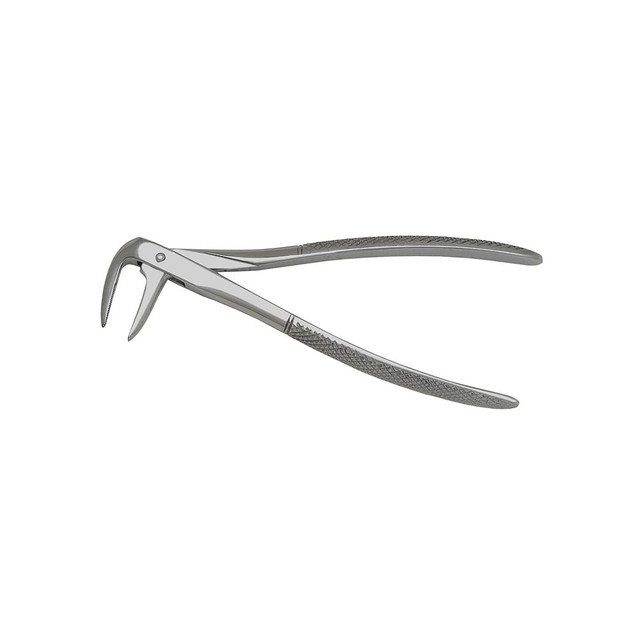
Extraction forceps are specialized handheld instruments designed for the removal of teeth from the alveolar bone. They operate on the principle of a first-class lever, multiplying the force applied to the handles to grasp the tooth securely at the root level.
1. General Description
Forceps consist of three primary parts:
- Beaks: The working ends that grasp the tooth. They are designed to fit the specific anatomy of the tooth root (e.g., pointed for furcations or rounded for single roots).
- Hinge: The joint that connects the handles to the beaks, transferring the pressure.
- Handles: The serrated or textured area held by the dentist to provide grip and leverage.
2. Key Features
- Anatomic Specificity: Forceps are “tooth-specific.” Upper forceps usually have straight or slightly curved handles, while lower forceps often have a 90-degree bend to allow better access to the mandibular arch.
- Serrated Beaks: Many modern forceps feature internal serrations on the beaks to increase friction and prevent the tooth from slipping during luxation.
- Ergonomic Design: Handles are shaped to fit the palm comfortably, allowing the clinician to apply controlled apical and lateral pressure.
- Material: Most are made of high-grade stainless steel or titanium-coated steel to withstand repeated autoclaving (sterilization) and high mechanical stress.
3. Common Types and Usage
Forceps are categorized by the arch (Upper vs. Lower) and the tooth type (Incisor, Premolar, Molar).
Upper Arch (Maxillary)
| Type | Target Teeth | Feature |
| Universal (No. 150) | Incisors, Canines, Premolars | Slightly “S” shaped; universal for most upper teeth. |
| Molar (No. 88 L/R) | Maxillary Molars | “Cowhorn” shape with a pointed beak to fit into the buccal furcation. |
| Root Tip | Remaining Roots | Very fine, narrow beaks for deep subgingival access. |
Lower Arch (Mandibular)
| Type | Target Teeth | Feature |
| Universal (No. 151) | Incisors, Canines, Premolars | Similar to 150 but with a downward curve for the lower arch. |
| Cowhorn (No. 23) | Mandibular Molars | Sharp, pointed beaks designed to seat into the bifurcation to “pump” the tooth up. |
| English Pattern | General | Vertical hinge design, often used for anterior teeth. |
4. Usage Protocol
The extraction process typically follows these mechanical steps:
- Dilation: Before using forceps, an elevator is often used to luxate (loosen) the tooth and expand the bony socket.
- Seating: The forceps beaks are placed as far apically (toward the root) as possible, beneath the gum line.
- Luxation: The clinician applies slow, steady pressure in a labial/buccal and lingual/palatal direction to expand the alveolar bone.
- Rotation/Traction: For single-rooted teeth (like incisors), a rotational movement is used. For multi-rooted molars, a “figure-eight” motion or buccal-heavy pressure is applied until the tooth is delivered.