
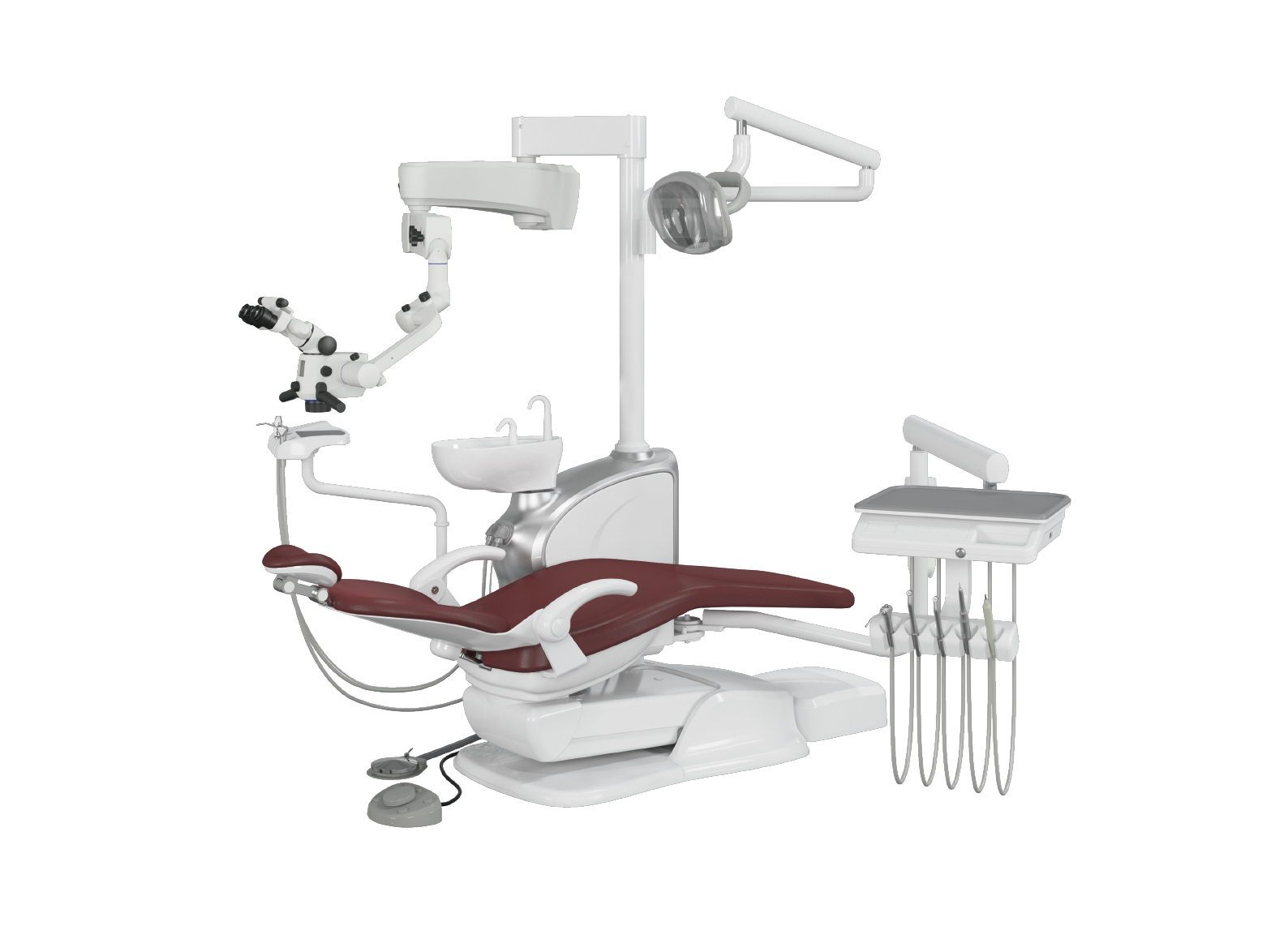
The dental chair is the central component of the dental operatory, designed to position patients comfortably while providing the dentist and dental assistant with optimal access to the oral cavity. Modern dental chairs are sophisticated ergonomic systems integrated with various clinical tools.
Description
A dental chair is a specialized medical device consisting of an adjustable seat, backrest, and headrest, usually mounted on a hydraulic or electric lift system. It is part of a larger “Dental Unit,” which typically includes the delivery system (handpiece consoles), the assistant’s instrumentation, the operatory light, and a cuspidor (spittoon) or high-volume suction system.
Key Features
- Ergonomic Articulation: Most chairs feature a “thin backrest” design to allow the dentist to get closer to the patient’s head. The headrest is usually multi-axis to accommodate different neck angles.
- Programmable Positioning: Modern chairs have memory settings for common positions:
- Entry/Exit: Lowered and upright for the patient to sit or stand.
- Supine: Flat for most restorative procedures.
- Trendelenburg: Head lower than feet, used for certain surgical needs or managing syncope.
- Integrated Delivery Systems: The chair often houses the controls for air-driven or electric handpieces, ultrasonic scalers, and 3-way syringes.
- Hygiene & Maintenance: High-quality upholstery is typically seamless and made of antimicrobial materials that can withstand medical-grade disinfectants.
- Foot Control: Allows hands-free adjustment of the chair’s height and tilt to maintain a sterile field during procedures.
Usage and Clinical Workflow
The effective use of a dental chair focuses on both patient comfort and the clinician’s long-term musculoskeletal health.
| Phase | Action |
| Patient Reception | Set the chair to the lowest upright position. Ensure the armrests are moved if necessary for easy entry. |
| Positioning | Recline the patient slowly. For maxillary (upper) work, the patient is usually in a full supine position. For mandibular (lower) work, the backrest is slightly raised. |
| Access | Adjust the headrest so the patient’s chin is tilted up or down as needed. Move the chair height so the dentist’s thighs are parallel to the floor and the patient’s mouth is at elbow height. |
| Safety | Always ensure the “Safety Auto-Stop” is functional—this prevents the chair from moving if it encounters an obstruction (like an assistant’s stool). |
| Post-Procedure | Return the chair to the upright position slowly to prevent the patient from experiencing orthostatic hypotension (dizziness). |
Types of Dental Chairs
- Pediatric Chairs: Often smaller and brightly colored, sometimes designed in shapes (like animals) to reduce dental anxiety in children.
- Surgical/Oral Surgery Chairs: Heavily padded with more stable bases to support patients during longer sedation or complex surgical procedures.
- Orthodontic Chairs: Usually simpler in design, as many orthodontic procedures do not require a full delivery unit or cuspidor.