
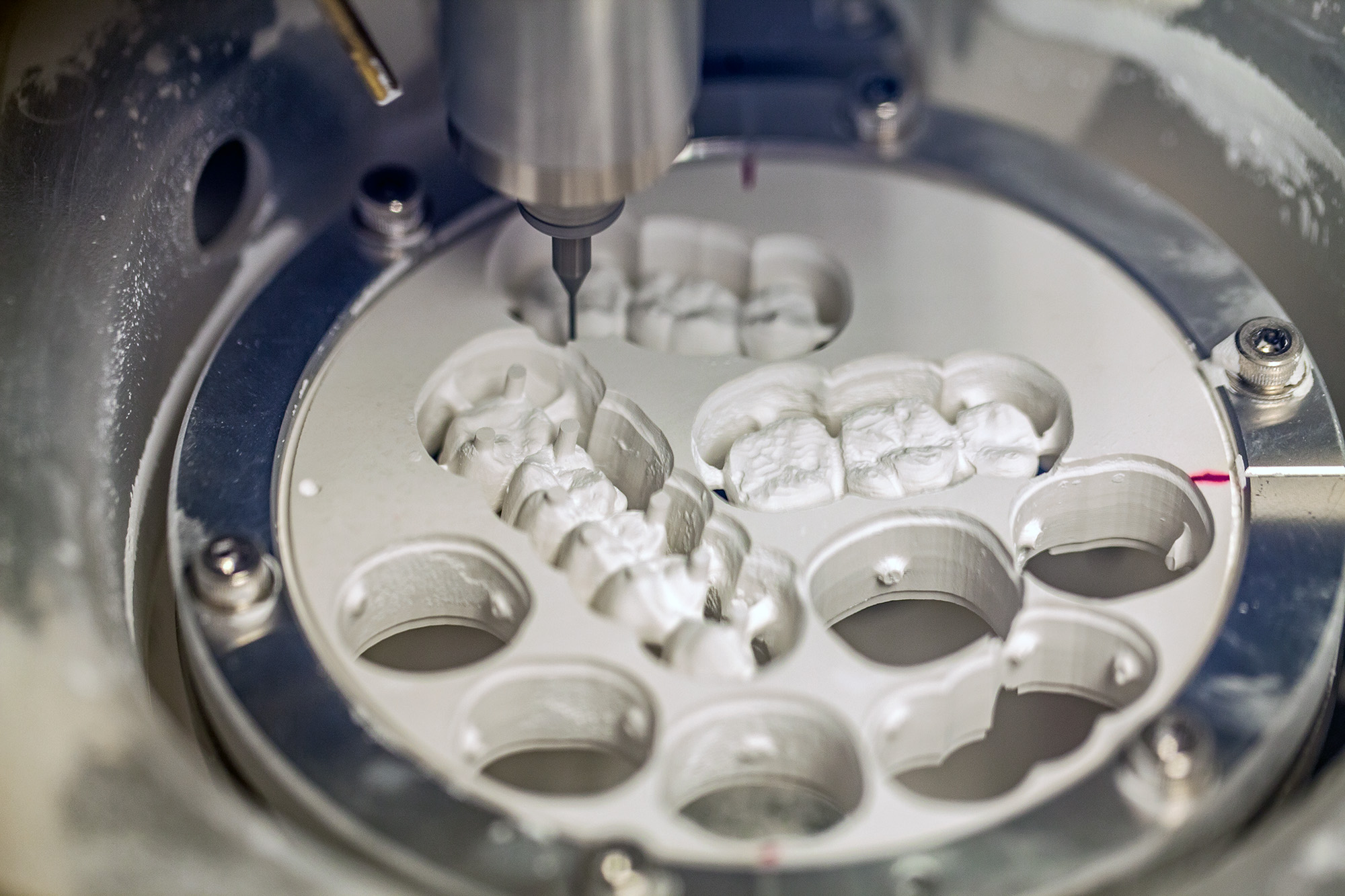
In modern dentistry, milling machines are the subtractive manufacturing heart of CAD/CAM (Computer-Aided Design/Computer-Aided Manufacturing) technology. They are used to carve dental restorations such as crowns, bridges, and veneers from solid blocks or discs of material.
Description
A dental milling machine is a high-precision computer-controlled device that uses rotary cutting instruments (burs) to remove material from a workpiece. These machines interpret digital designs sent from dental CAD software and translate them into physical objects with micron-level accuracy.
They are generally categorized by the number of axes they operate on:
- 4-Axis Milling: Can rotate the part and move the tool in three linear directions. Best for simple crowns and bridges.
- 5-Axis Milling: Adds a second rotational axis, allowing the tool to reach deep undercuts and complex geometries, which is essential for large-span bridges and implant bars.
Key Features
- Wet vs. Dry Milling: * Dry Milling: Used for materials like Zirconia and PMMA. It uses vacuum systems to remove dust.
- Wet Milling: Uses a liquid coolant to prevent heat damage. It is required for glass ceramics (like lithium disilicate) and metals (like Titanium or CoCr).
- Automatic Tool Changer (ATC): Allows the machine to switch between different bur sizes (e.g., from a coarse $2.5mm$ bur to a fine $0.6mm$ bur) without manual intervention.
- Spindle Speed: High-speed spindles (often ranging from 30,000 to 100,000 RPM) ensure smooth surfaces and prevent material chipping.
- Material Compatibility: Modern machines can handle various formats, including 98mm discs (industry standard) and blocks (for chairside use).
Usage and Workflow
The integration of a milling machine into a dental workflow typically follows these steps:
- Scanning: A digital impression is taken using an intraoral scanner or by scanning a traditional stone model.
- Design (CAD): The restoration is designed on a computer, defining margins, occlusion, and anatomy.
- Nesting (CAM): The design is placed within a virtual material block/disc. This software calculates the “toolpath” or the movements the burs will take.
- Milling: The data is sent to the machine. The milling process can take anywhere from 8 to 20 minutes for a single crown, depending on the material and detail level.
- Post-Processing: Once milled, the restoration is removed from the “sprue,” polished, and, in the case of Zirconia, placed in a sintering furnace to reach its final strength and color.
Comparison of Milling Types
| Feature | Chairside Milling (In-Office) | Lab-Scale Milling (Production) |
| Primary Goal | Same-day restorations | High-volume production |
| Axis Count | Usually 4-axis | Often 5-axis |
| Materials | Glass ceramics, Composite blocks | Zirconia, Titanium, CoCr, PMMA |
| Footprint | Compact, desktop size | Large, industrial-grade |