
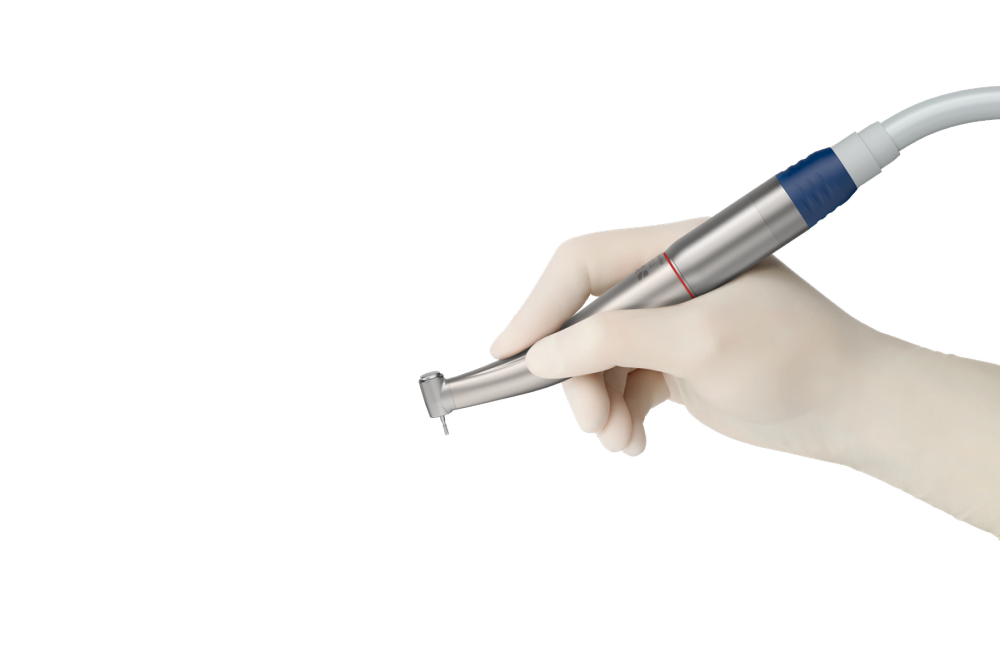
Electric handpieces are a sophisticated alternative to traditional air-driven systems. Driven by an internal electric motor, they provide consistent torque and speed control, offering a high level of precision for various dental procedures.
Description
An electric handpiece system consists of an electric micromotor (the power source) and interchangeable attachments (the handpiece heads). Unlike air-driven turbines that rely on compressed air to spin a small rotor, the electric motor uses a gear-driven mechanism. This allows the bur to maintain a constant speed regardless of the resistance or density of the tooth structure.
Attachments are typically color-coded for easy identification:
- Red Band (1:5 ratio): High-speed (up to 200,000 RPM) for cavity and crown preparation.
- Blue Band (1:1 ratio): Standard speed (up to 40,000 RPM) for caries removal and refining.
- Green Band (Reduction ratio, e.g., 5:1): Low-speed for endodontics or prophylaxis.
Key Features
- Constant Torque: The motor does not “stall” or slow down when it hits hard enamel or old restorative materials.
- Concentricity: Because the bur is gear-driven, it exhibits minimal vibration (chatter), resulting in a smoother, more precise cut.
- Quiet Operation: They produce a lower-frequency hum compared to the high-pitched whistle of air-driven turbines, which can reduce patient anxiety.
- Adjustable Speed Control: Many systems feature a digital console allowing the clinician to set exact RPMs for specific tasks.
- Internal LED Lighting: Most modern electric handpieces provide superior visibility via fiber-optic or LED glass rods.
Usage and Clinical Procedure
Electric handpieces are versatile and used across almost all dental specialties:
| Procedure | Recommended Attachment | Usage Note |
| Crown & Bridge Prep | Red Band (1:5) | High torque allows for fast, smooth margin definition and bulk reduction. |
| Caries Removal | Blue Band (1:1) | Constant speed prevents the bur from grabbing, providing better tactile feedback. |
| Polishing/Prophy | Green Band (4:1/5:1) | Prevents overheating of the tooth surface during finishing. |
| Endodontics | Reduction Handpiece | Used with specific torque-control settings to prevent file breakage. |
Maintenance and Care
To ensure the longevity of the gear-driven mechanism:
- Cleaning: Wipe the external surface to remove debris. Never submerge the motor in an ultrasonic cleaner.
- Lubrication: Proper oiling is critical for the internal gears. Use the manufacturer-specified lubricant before every autoclave cycle.
- Sterilization: Only the attachments (heads) are typically autoclaved; the motor itself usually requires a specific protective sleeve or specialized sterilization protocol.