
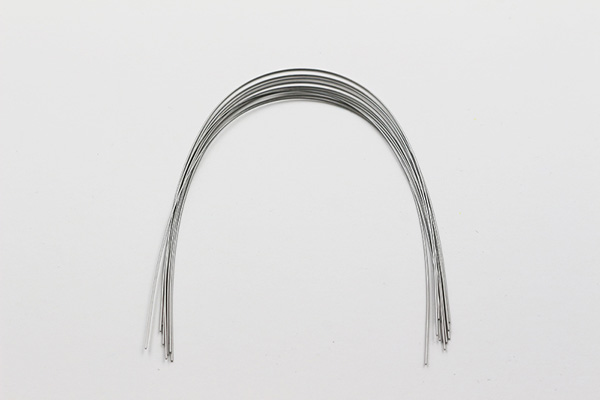
In orthodontics, archwires are the active components of a fixed appliance system. While brackets act as the “handles” on the teeth, the archwire is the “engine” that provides the necessary force to move teeth into their desired positions.
1. Description
An archwire is a metal wire formed to the ideal shape of a dental arch. It is inserted into the horizontal slots of orthodontic brackets and secured (ligated) in place. Through the principles of elasticity and shape memory, the wire attempts to return to its original pre-formed shape, dragging the teeth along with it.
2. Key Material Types
The performance of an archwire depends heavily on its metallurgical composition:
- Nickel-Titanium (NiTi): * Characteristics: Highly flexible with “super-elasticity.”
- Function: Used in the initial stages of treatment. It can be severely deformed to reach crooked teeth without permanent bending.
- Thermal Activation: Some NiTi wires are “heat-activated,” meaning they remain soft at room temperature but become active and stiffen once they reach the temperature of the patient’s mouth.
- Stainless Steel (SS):
- Characteristics: High stiffness and low friction.
- Function: Used in the mid-to-late stages. Because it is rigid, it is excellent for maintaining the arch shape and closing gaps (sliding mechanics).
- Beta-Titanium (TMA):
- Characteristics: A “middle ground” material. It is more flexible than steel but stiffer than NiTi.
- Function: Used for detailed finishing bends and patients with nickel allergies.
3. Features: Shapes and Sizes
Archwires are classified by their cross-sectional shape and thickness (measured in thousandths of an inch):
- Round Wires: (e.g., .014, .016)
- Touch the bracket slot at only one point.
- Purpose: Allow for leveling and aligning with minimal friction.
- Rectangular/Square Wires: (e.g., .016 x .022, .019 x .025)
- Fill the bracket slot more completely.
- Purpose: Control the torque (root movement) and angulation of the teeth.
4. Clinical Usage & Progression
Orthodontic treatment follows a specific “wire sequence” to ensure tooth movement is safe and efficient:
| Stage | Goal | Typical Wire Used |
| Stage 1: Alignment | Straightening rotations and leveling the height of teeth. | Small Round NiTi (e.g., .012 or .014 NiTi) |
| Stage 2: Space Closure | Closing gaps and correcting the bite (overjet/overbite). | Rectangular Stainless Steel (e.g., .019 x .025 SS) |
| Stage 3: Finishing | Final micro-adjustments and root positioning. | TMA or Braided Steel |
Summary Table
| Feature | NiTi Wires | Stainless Steel Wires |
| Flexibility | Very High | Low (Stiff) |
| Shape Memory | Yes | No (Can be permanently bent) |
| Friction | Moderate | Lowest |
| Primary Use | Initial Crowding | Space Closure & Stability |