1. Description & Classifications
Dental surface disinfectants are typically categorized by their “kill level” and regulatory approval:
- Hospital-Grade Disinfectants: These are EPA-registered (or locally equivalent, such as TGA-listed) and must be effective against Staphylococcus aureus, Salmonella enterica, and Pseudomonas aeruginosa.
- Intermediate-Level Disinfectants: These have a tuberculocidal claim (effective against Mycobacterium tuberculosis). In dentistry, these are required for surfaces visibly contaminated with blood or body fluids.
- Low-Level Disinfectants: These are effective against most bacteria and some viruses but do not kill tuberculosis or bacterial spores. They are used for non-critical surfaces with no visible blood.
2. Key Features
Modern dental disinfectants are designed for high-turnover environments and often include:
- Broad Spectrum Efficacy: Effective against a wide range of pathogens including HIV, HBV, HCV, MRSA, and Influenza.
- Fast Contact Time: Many professional products, such as CaviWipes, feature a 1-minute to 2-minute “kill time” to allow for quick room turnover.
- Material Compatibility: Formulations are often non-corrosive and bleach-free to protect sensitive dental equipment, such as vinyl upholstery on dental chairs.
- One-Step Action: Many are “dual-purpose,” meaning they act as both a detergent (cleaner) and a disinfectant, allowing for faster processing.
3. Usage & Techniques
Proper usage is critical to ensure the chemical actually kills the pathogens:
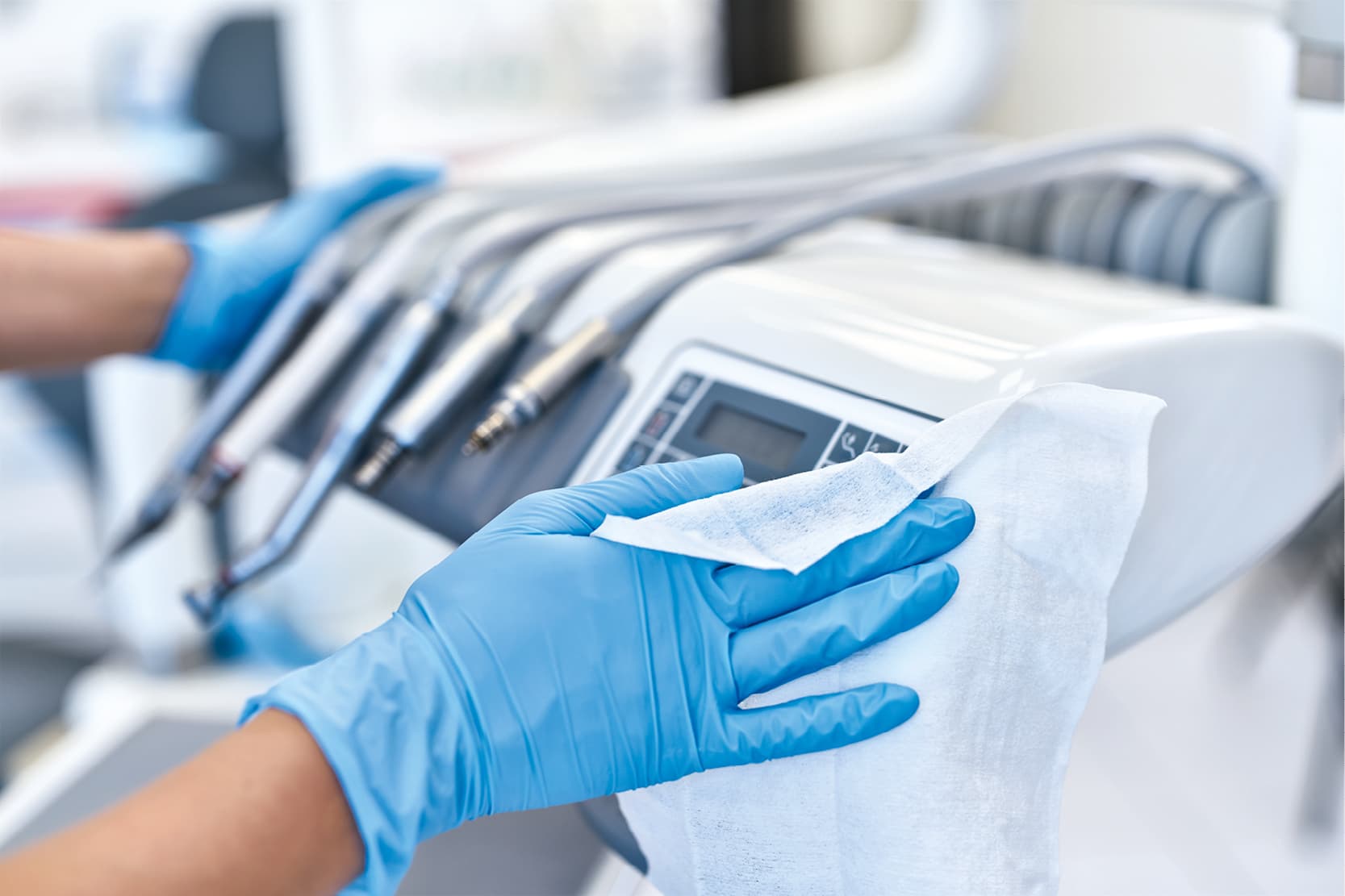
- Pre-cleaning (The “2-Step” Method): Disinfectants cannot work effectively through organic debris like blood or saliva. You must first wipe the surface clean to remove bioburden, then apply a fresh layer of disinfectant.
- Spray-Wipe-Spray Technique: A common protocol where you spray to clean, wipe it away, then spray again and leave it wet.
- Stay-Wet Contact Time: The surface must remain visibly wet for the full duration specified on the product label (e.g., 2 minutes) to achieve the stated kill rate.
- Surface Barriers: For difficult-to-clean areas (like keyboards or light switches), it is best to use disposable plastic barriers in addition to chemical disinfection.