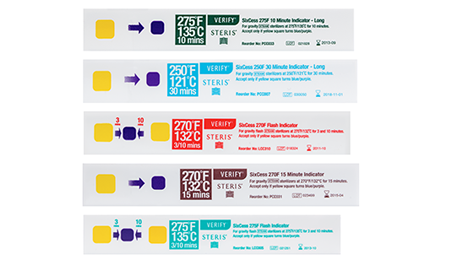
Description: These are chemical-based monitors (usually in the form of strips or tape) that change color when exposed to specific sterilization parameters. They are categorized by “Types” (formerly Classes) based on the level of detail they monitor.
Key Features:
Color-Change Technology: A clear, high-contrast color transition (e.g., from off-white to black) that is easy for dental staff to read.
Type 1 (Process Indicators): Usually found on the outside of a pouch or as “Autoclave Tape.” They only confirm that the package has been processed.
Type 4 (Multi-variable Indicators): Placed inside the pouch to react to two or more critical parameters (e.g., time and temperature).
Adhesive Backing: Some versions are stickers that can be easily transferred to a patient’s sterilization log or chart.
Usage:
Placement: Place a strip inside every sterilization pouch or wrap, and use indicator tape on the outside of larger surgical cassettes.
Verification: After the cycle, the dental assistant checks the strip. If the color has not changed to the “safe” indicator, the instruments are considered non-sterile and must be re-processed.
2. Chemical Integrators (Type 5)
Description: Integrators are more sophisticated than standard indicators. They are designed to react to all critical variables of the sterilization cycle (steam, time, and temperature). Their performance is engineered to parallel the death rate of highly resistant bacterial spores.
Key Features:
Moving Front Technology: Instead of a simple color change, these often feature a “wicking” design where a dark bar migrates into a “Pass” or “Fail” zone.
High Accuracy: They provide a higher level of confidence than Type 1 or 4 indicators because they require a complete cycle to reach the “Accept” result.
No Lab Incubation: Unlike Biological Indicators (Spore Tests), Integrators provide immediate results at the end of the cycle.
Usage:
Load Monitoring: Used inside a “challenge pack” or placed in the center of the most crowded area of the autoclave load.
Emergency Release: Often used to monitor loads containing implantable items (though biological monitoring is still the gold standard for implants).
3. Biological Indicators (Spore Tests)
Description: The most definitive method of sterilization monitoring. These consist of a standardized population of resistant bacterial spores (typically Geobacillus stearothermophilus) in a vial or on a paper strip.
Key Features:
Direct Kill Measurement: This is the only tool that proves the autoclave is actually killing microorganisms, not just reaching a certain temperature.
In-Office or Mail-In: Available as self-contained vials that can be incubated in the dental office, or strips that are mailed to a third-party laboratory for verification.
Compliance Ready: Provides the necessary documentation for health department inspections and OSHA/CDC compliance.
Usage:
Frequency: Usually performed weekly (or daily in high-volume clinics) to validate autoclave performance.
The Process: A test vial is placed in a normal cycle. After the cycle, the vial is “activated” and incubated for a set period (ranging from 24 hours to as little as 20 minutes for high-speed systems). If the liquid remains the original color, the test is a “Pass.”
4. Bowie-Dick Test Packs
Description: Specific tests designed for Type B (Pre-vacuum) autoclaves to detect air leaks and ensure proper vacuum performance and steam penetration.
Key Features:
Air-Removal Detection: Specifically monitors the efficiency of the vacuum pump in removing air from the chamber.
Single-Use: Pre-packaged to ensure consistent testing conditions every time.
Usage:
Daily Routine: Should be performed at the start of every clinical day, before the first load of instruments, to ensure the autoclave is functioning correctly.