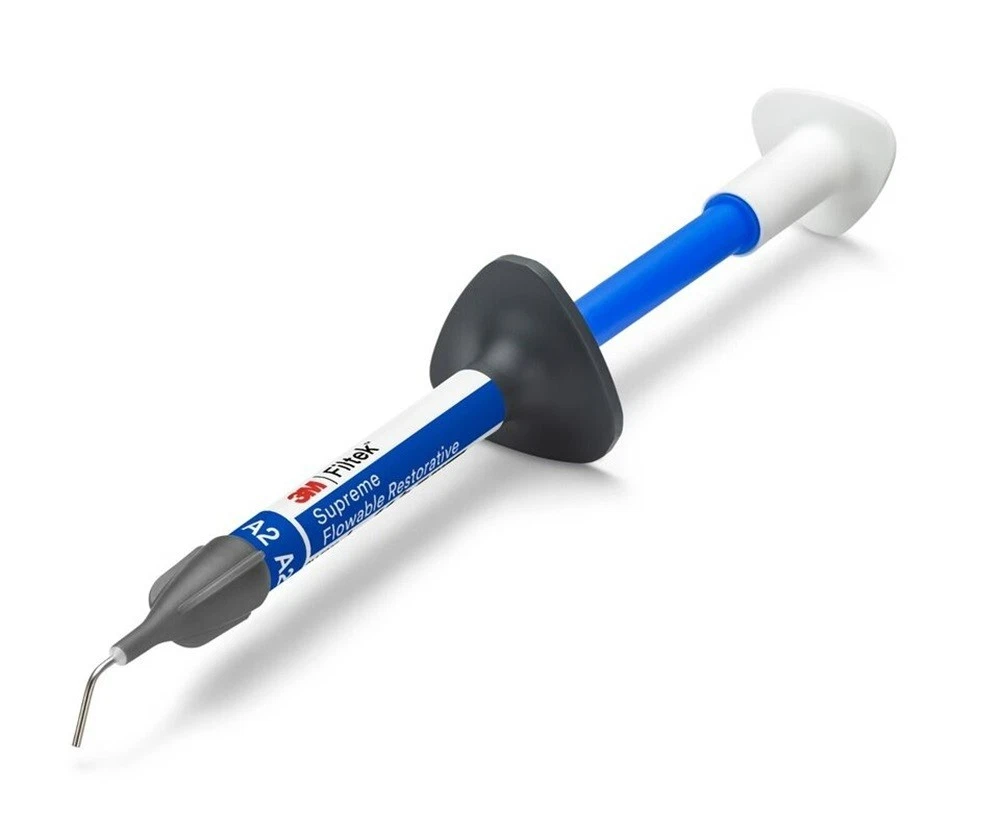
Vinyl Polysiloxane (VPS), also commonly referred to as PVS (Polyvinyl Siloxane), is an addition-reaction silicone. It is widely regarded as the “gold standard” for precision impressions in modern restorative dentistry due to its extraordinary accuracy and dimensional stability.
Description
VPS is an elastomeric impression material composed of a base paste and a catalyst paste. When mixed (usually via an auto-mix gun), a chemical reaction occurs between vinyl groups and hydrogen-terminated siloxane groups. Unlike older “condensation” silicones, VPS produces no by-products (like alcohol or water) during polymerization, which is the key to its incredible stability.
It is available in various viscosities to suit different clinical needs:
- Extra-Light/Light Body: High flow to capture subgingival details.
- Regular/Medium Body: Balanced flow for one-step techniques.
- Heavy Body/Putty: High stiffness to provide tray support and prevent deformation.
Key Features
- Superior Dimensional Stability: VPS has the lowest polymerization shrinkage (approximately $0.05\%$) of all impression materials. Models can be poured weeks after the impression is taken without losing accuracy.
- High Elastic Recovery: It returns to its original shape after being stretched over undercuts, with a recovery rate of nearly $99.5\%$.
- High Tear Strength: It resists tearing when being removed from tight interproximal spaces or deep gingival sulci.
- Hydrophilic Options: While naturally hydrophobic (water-repelling), modern VPS formulas include surfactants to improve flow in the presence of minor moisture.
- Multiple Pour Capability: Because it is so stable, a single VPS impression can be used to pour multiple stone models.
Usage and Clinical Procedure
The most common application for VPS is the Two-Stage or One-Step Double-Mix technique used for crowns, bridges, and implants.
1. Preparation
- Ensure the tooth is cleaned and the gingiva is retracted (using retraction cord or paste) to expose the finish line.
- Crucial: Do not use latex gloves when hand-mixing VPS putty, as sulfur in the latex can inhibit the setting reaction (leaving the material tacky).
2. Mixing and Placement
- Heavy Body/Putty: Placed into the impression tray to act as the “engine” that pushes the lighter material into the sulcus.
- Light Body: Syringed directly onto the prepared tooth and into the gingival sulcus.
3. Setting and Removal
- The tray is seated in the mouth and held steady. Setting time typically ranges from 3 to 5 minutes depending on the “Regular” or “Fast Set” formulation.
- Once set, the tray is removed with a quick, firm pull to minimize permanent deformation.
4. Disinfection and Pouring
- The impression is rinsed and disinfected. Unlike Alginate, VPS does not need to be poured immediately. It is recommended to wait at least 15–30 minutes before pouring stone to allow for the release of any residual hydrogen gas (though modern materials have largely eliminated this “gassing” issue).
Comparison Summary
| Feature | VPS (Vinyl Polysiloxane) | Alginate (Comparison) |
| Accuracy | Extremely High | Moderate |
| Pour Time | Flexible (up to weeks) | Immediate (within 15 mins) |
| Cost | High | Low |
| Detail Recovery | Excellent | Fair |