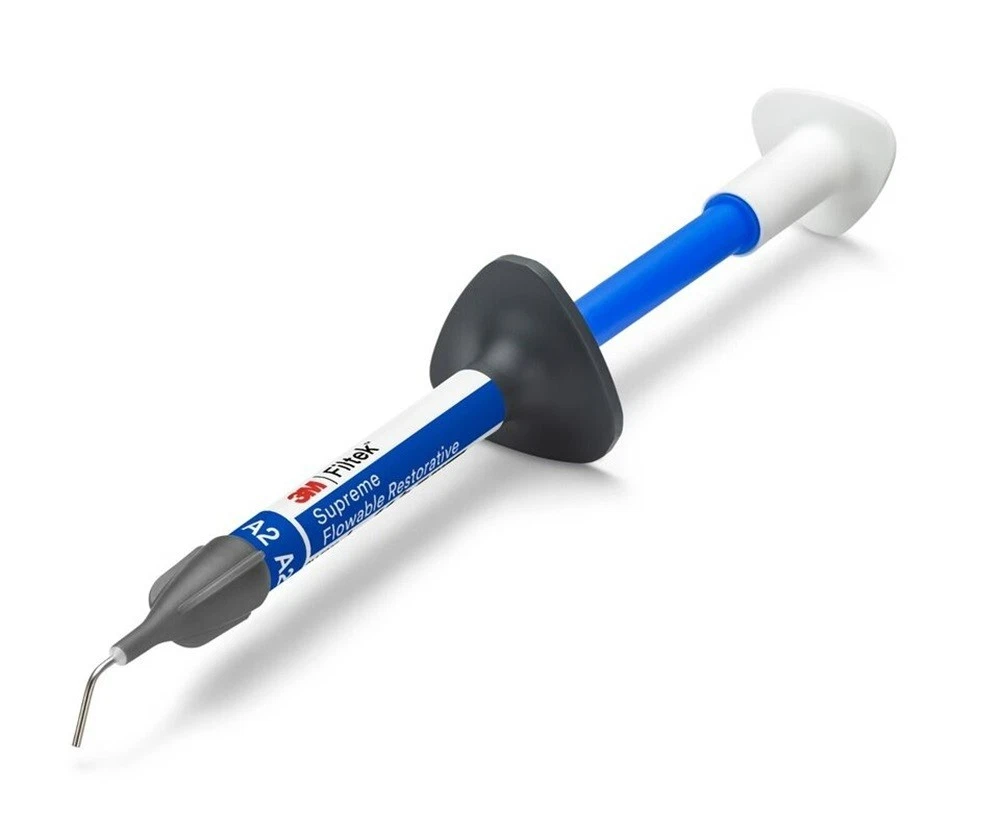
Flowable composites are a versatile class of restorative materials characterized by their low viscosity and high “flow” compared to traditional universal composites. They were developed to simplify placement in hard-to-reach areas and to act as a stress-reducing liner beneath more rigid materials.
What are Flowable Composites?
In simple terms, a flowable composite is a tooth-colored resin with a reduced filler content (typically 37% to 53% by volume, compared to 60%+ for packable composites). This change in the filler-to-resin ratio allows the material to adapt easily to the internal geometry of a tooth preparation without the need for heavy hand instruments.
Key Features
- Low Viscosity: The “runny” consistency allows the material to wet the tooth surface effectively, filling microscopic irregularities and undercuts.
- High Ethics & Aesthetics: Modern flowables come in various shades and opacities, allowing them to blend seamlessly with natural enamel.
- Elasticity: They often have a lower Modulus of Elasticity than universal composites, which helps them act as a flexible “cushion” that absorbs shrinkage stress during polymerization.
- Thixotropic Properties: Many high-quality flowables are designed to stay put once placed and only “flow” when manipulated by a tool or needle tip.
- Radiopacity: They are engineered to show up clearly on X-rays, allowing for easy monitoring of the restoration over time.
Common Usage and Applications
Flowable composites are rarely used for high-stress areas like the biting surfaces of back teeth, but they excel in the following scenarios:
1. Cavity Liners and Bases
Used as the first layer in a deep restoration (the “snowplow technique”) to ensure there are no voids between the tooth and the restorative material.
2. Class V Restorations
Ideal for treating cervical lesions (notches near the gum line) because the material’s flexibility helps it withstand the natural flexing of the tooth under pressure.
3. Preventive Resin Restorations (PRR)
Used to seal deep pits and fissures in molars where a full cavity hasn’t formed yet, but protection is needed.
4. Minor Repairs
- Repairing small chips in porcelain or composite veneers.
- Filling small voids or “blowholes” in existing restorations.
- Re-margining temporary crowns.
5. Orthodontic Bonding
Commonly used to bond orthodontic brackets or lingual retainers to the teeth due to the ease of application around the hardware.
Comparison at a Glance
| Feature | Flowable Composite | Universal (Packable) Composite |
| Filler Content | Lower (37–53%) | Higher (60–80%+) |
| Wear Resistance | Moderate | High |
| Adaptability | High (Self-leveling) | Low (Requires packing) |
| Polymerization Shrinkage | Generally Higher | Generally Lower |