
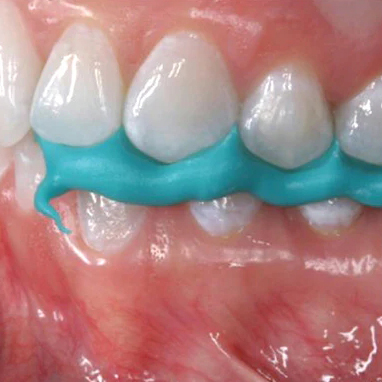
Bite Registration (also known as occlusal registration or interocclusal record) is a clinical procedure used to capture the precise relationship between the upper (maxillary) and lower (mandibular) teeth. This record allows dental technicians to accurately mount diagnostic or working models on an articulator, replicating the patient’s unique bite outside of the mouth.
Description
Historically, bite registrations were made using baseplate wax or zinc oxide-eugenol paste. Today, the industry standard has shifted toward specialized addition-reaction silicone (VPS) materials. These materials are specifically formulated to be “thixotropic”—meaning they flow easily under pressure but stay in place on the occlusal surfaces without running down the patient’s throat.
Key Features
- High Shore Hardness: Once set, the material is extremely rigid. This prevents any “spring” or compression when the stone models are pressed into the record, ensuring the bite isn’t “opened” during lab work.
- Fast Setting Time: Most modern bite registration materials set within 30 to 60 seconds in the mouth. This minimizes the risk of the patient moving their jaw during the procedure.
- Minimal Resistance: The material offers almost zero resistance to closure, allowing the patient to close into their natural Centric Occlusion (CO) or Centric Relation (CR) without the material interfering with the jaw’s path.
- Dimensional Stability: Unlike wax, silicone-based records do not warp or melt during shipping or storage, maintaining accuracy for weeks.
- Easy Trimming: High-quality records can be easily trimmed with a scalpel or lab bur without shattering or tearing.
Usage and Clinical Procedure
A precise bite registration is critical for the success of crowns, bridges, implants, and orthodontic appliances.
| Step | Action |
| Preparation | Dry the occlusal surfaces of the teeth. Ensure the patient understands the closing path by practicing the “bite” several times before applying material. |
| Application | Use an automix gun to apply the material directly onto the occlusal surfaces of the mandibular teeth or the preparation site. |
| Closure | Instruct the patient to close into the practiced position. Monitor the patient to ensure they do not shift their jaw laterally. |
| Setting | Wait for the manufacturer’s specified time (usually indicated by a color change or a “snap” set feel). |
| Evaluation | Remove the record and inspect for perforations (which often indicate tooth-to-tooth contact) and sharp detail of the cusp tips. |
| Trimming | Trim away any excess material that extends into undercuts or soft tissue areas to ensure the models seat perfectly into the record. |
Comparison: Wax vs. Silicone (VPS)
| Feature | Wax Records | Silicone (VPS) Records |
| Accuracy | Moderate (prone to distortion) | High |
| Durability | Temperature sensitive | Stable |
| Hardness | Soft/Flexible | Rigid/Hard |
| Ease of Use | Requires heating | Automix (Room Temp) |